Usami Laboratory

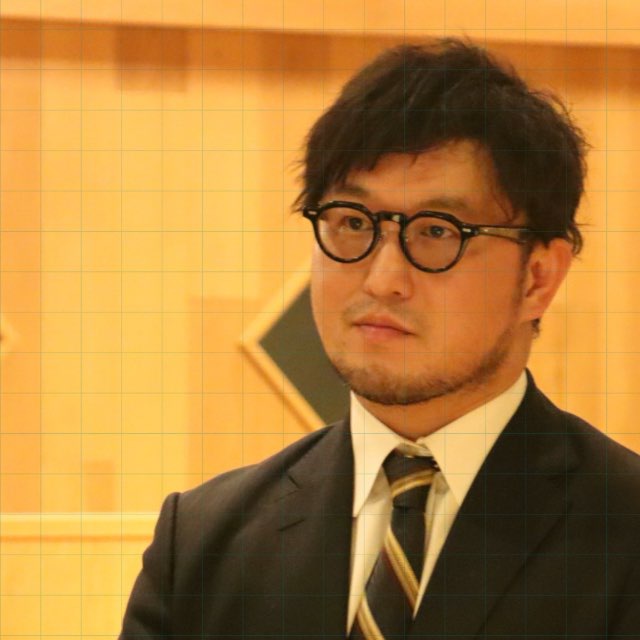
Hiroyasu Usami

Hiroyasu Usami

宇佐美 裕康

Senior Assistant Professor. Ph.D. in Engineering. Researcher, Aichi Medical University.

I am a Senior Assistant Professor at Chubu University and lead Usami Laboratory. I study how light interacts with objects and environments and what information images can reveal. Through mathematical analysis and reproducible experiments, I examine the conditions behind measurement and inference, and extend these ideas to validating AI estimation, generation, and evaluation. I have served as an Editorial Board Member of Scientific Reports since September 2026.

Affiliation
Department of Computer Science, College of Engineering, Chubu University
Researcher, Aichi Medical University
Expertise
light and image formation, computer vision, medical image analysis, mathematical analysis of machine learning, and AI/LLM evaluation
Research Themes
understanding light and image formation, conditions and limits of measurement and inference, and validation of AI estimation, generation, and evaluation. Applications include medical imaging, 3D reconstruction, spatiotemporal data, and LLMs.
Collaboration and Research Infrastructure
In collaborative mHealth research in rural Thailand, I work on information-sharing and data-collection systems. My industry collaborations cover generative AI and LLM evaluation, research-server and GPU computing infrastructure, and systems that connect data storage with analysis.
Teaching and Research Supervision
I teach computer graphics, applied C programming, Advanced Computer Vision A, and laboratory classes on server construction. My teaching experience also includes advanced simulation engineering and experiments involving A/D and D/A conversion and H8 microcontrollers. I supervise undergraduate and graduate research.
Research Record

122research outputs

8academic awards

Chubu University faculty-database snapshot, updated 2026-10-08 and verified 2026-10-10. Includes one accepted, forthcoming work and joint awards.
Recent preprints

Current arXiv versions of studies in machine learning and polarization estimation. These preprints have not been peer reviewed.

Preprint · Not peer reviewed

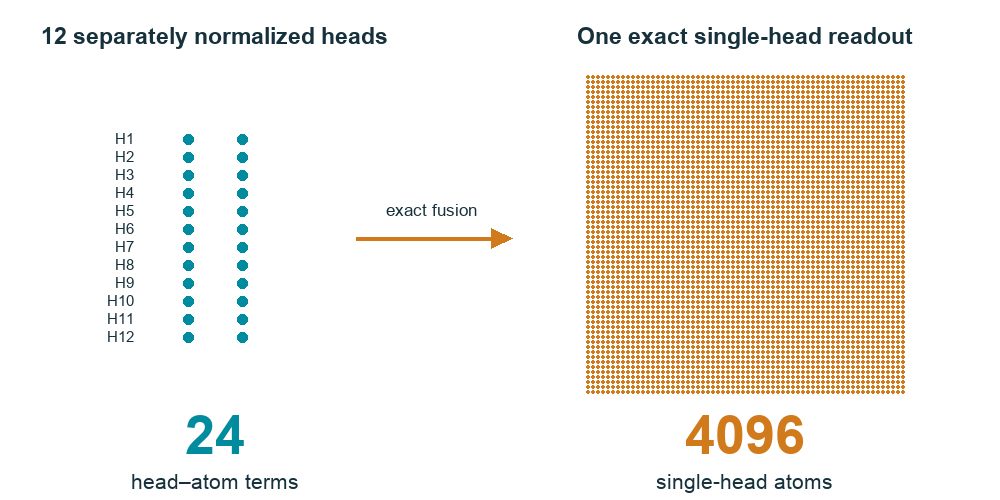
Exact Fusion of Softmax Attention Heads Can Require Exponentially Many Atoms

The paper constructs independently normalized attention heads whose exact fusion into one head requires exponentially more key-value entries. The preprint and reproduction materials are available.

Hiroyasu Usami, Keisuke Hara, Ayato Tsuboi, Naohiko Matsuda

Twelve separately normalized two-atom heads, with 24 head–atom terms, compared with 4,096 atoms in one exact single-head readout.
In this constructed example, 12 two-atom heads use 24 head–atom terms; an exactly equivalent single-head representation requires at least 4,096 atoms.
Preprint · Not peer reviewed

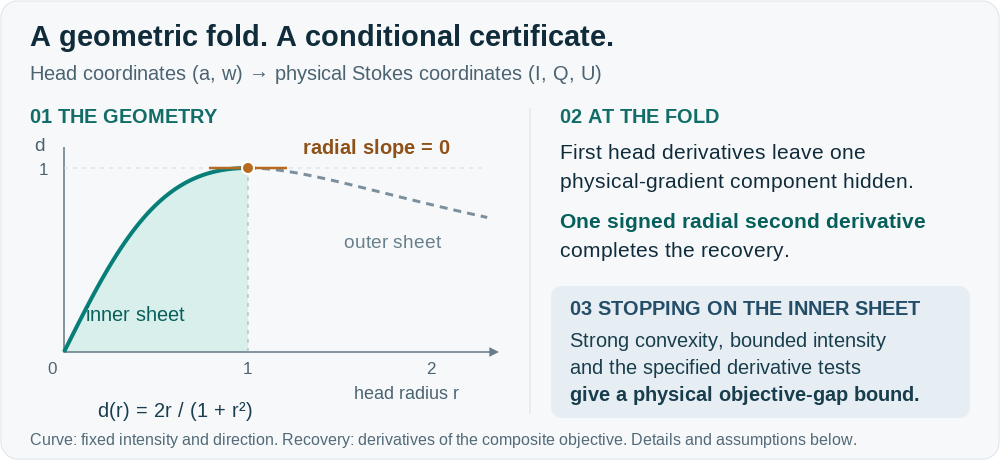
Conditional stopping guarantees for a folded parametrization of reduced Stokes vectors

Derives an objective-gap bound from derivative and curvature tests for strongly convex physical objectives on the bounded-intensity inner sheet of a folded Stokes parametrization, including partial linear polarization.

Hiroyasu Usami, Ayato Tsuboi, Keisuke Hara

The fold in a Stokes parametrization and the additional conditions for an inner-sheet stopping certificate.
An English-language animation explaining the Stokes fold. Stopping guarantees require the convexity, domain, and error conditions specified in the paper.
Preprint · Not peer reviewed

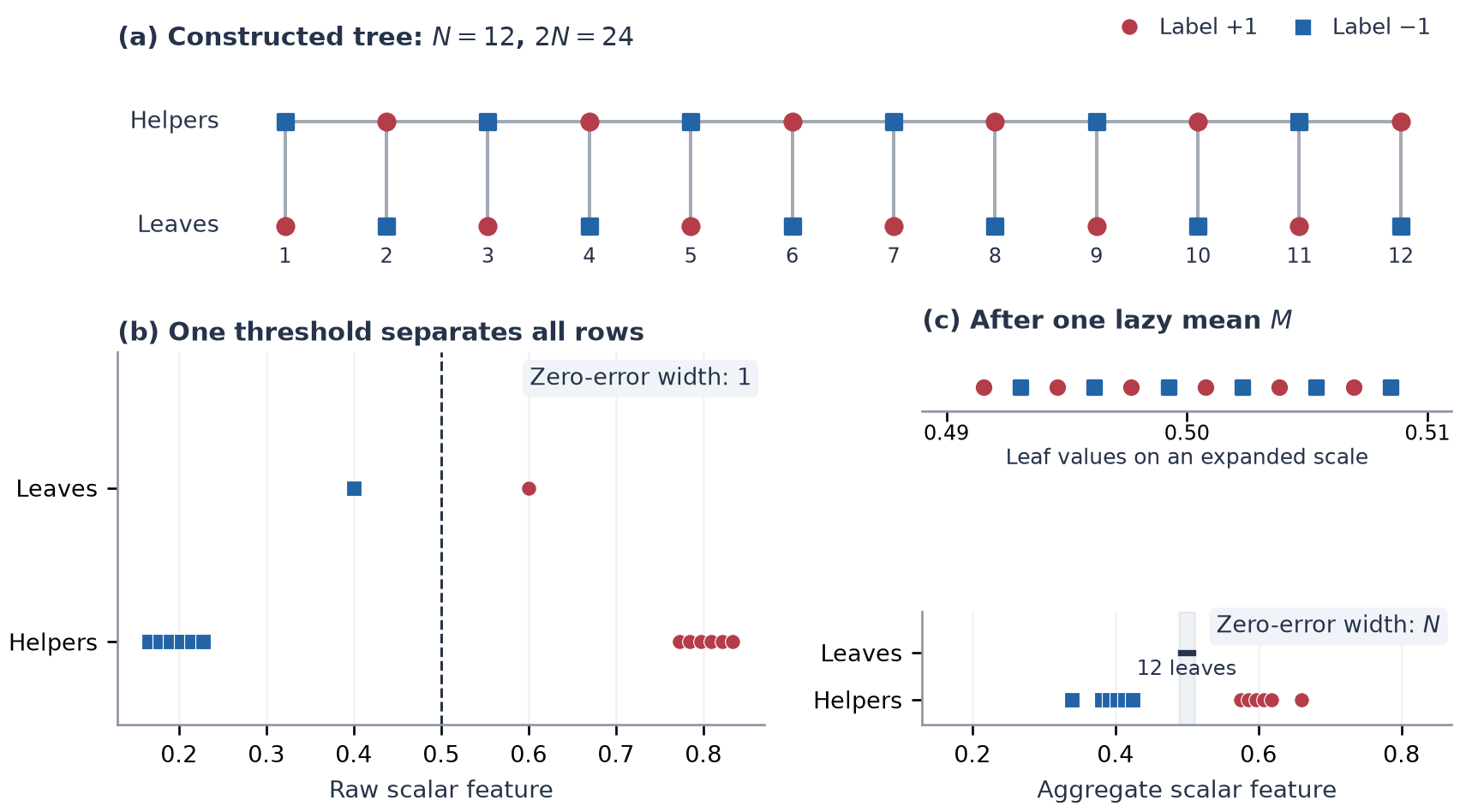
Invertible Graph Aggregation Can Increase ReLU Readout Width

Studies how invertible graph aggregation can increase the width needed by a shared nodewise ReLU classifier with one hidden layer, using an explicit tree construction, perturbation and noise bounds, controlled fits, and public-graph comparisons.

Hiroyasu Usami, Masanori Tsukamoto, Kohei Hashiguchi

Constructed 24-node tree and scalar feature orders before and after averaging. Raw features separate at one threshold; aggregated leaf labels alternate.
In this constructed tree (N = 12), one invertible averaging step raises the minimum width of a shared one-hidden-layer ReLU classifier from 1 to 12 for zero classification error.

Explore the research

Testing LLM judges as measuring instruments

We test LLM judges as measuring instruments: whether verdicts can be read as specified, whether identical answers receive non-tie judgments, and how accurately a target is selected under declared criteria.

Anatomy-Preserving Augmentation via Generative AI

A workflow for augmenting medical training images with anatomical controls and generated-sample selection.

Separating Shape and Reflectance from a Single Image

A self-supervised method estimating scene properties like reflectance and shape from a single photo using relighting constraints.

Building IoT Prediction with Sparse Graphs and Physical Constraints

Spatiotemporal prediction that limits graph neighbors and incorporates bandwidth and connection constraints into training.

Mobile Extraction of Carotid Ultrasound IMT Regions

A conference abstract combining MobileNetV3 image classification with SegNet segmentation to examine efficient carotid ultrasound analysis.

Recommending Learning Actions from Activity Logs

A study of learning-action recommendations evaluated through changes in a grade predictor's outputs when activity logs are modified.

Image Translation for Polyp Detection Training

A study augmenting polyp-detector training with NBI-like images generated from white-light endoscopy.

Recovering Polyp Shape and Scale Using a Medical Suture

A study using a known-diameter suture and a lighting model to estimate approximate polyp shape and absolute scale from one endoscope image.

Polyp Shape Recovery with Two Lights and Normal Correction

A study combining a two-light photometric model with learned normal correction to estimate depth and shape from endoscope imagery.

Academic Service

I contribute to journal editing, conference committees, peer review, and academic society activities.

PeriodOrganizationRole
Since September 2026Scientific Reports (Nature Portfolio)Editorial Board Member
2026NeurIPS 2026 Workshop TAEReviewer
Since April 2026Information Processing Society of Japan (IPSJ)Representative Member
Since 2024Information Processing Society of Japan (IPSJ)Senior Member
Since June 2021IPSJ Journal / Journal of Information Processing (JIP)Editorial Board Member
Since 2025KES InternationalInternational Programme Committee Member
Since March 2020MICCAIReviewer
Since 2016IARIA PATTERNSTechnical Program Committee Member
Since 2025KES-InMedInternational Programme Committee Member
April 2024 – June 2026IPSJ Tokai BranchOperating Committee Member and Secretary
April 2023 – March 2024IPSJ Tokai BranchOperating Committee Member

Collaboration and Contact

We welcome collaboration, talks, and media inquiries on light and image formation, the conditions of measurement and inference, medical image analysis, and AI estimation, generation, and evaluation. Our broader work also includes generative data augmentation and edge-cloud computing.

Research Collaboration

We welcome collaboration on light and image formation, the conditions of measurement and inference, medical image analysis, and AI estimation, generation, and evaluation.

View collaboration guide

Media and Invited Talks

Contact us for interviews and talks on light and image understanding, AI and LLM evaluation, and the connection between mathematical analysis and reproducible evidence.

Contact by email

Research Outputs

Explore our papers, conference presentations, and other research outputs.

View research outputs